radiological · Niagara County
Niagara Falls Storage Site
Lewiston
Federal site within the former Lake Ontario Ordnance Works where a 10-acre engineered structure still holds radioactive residues, contaminated soil, and demolition debris. Complete removal and out-of-state disposal were selected, but removal is not complete.
The documented story
What happened here?
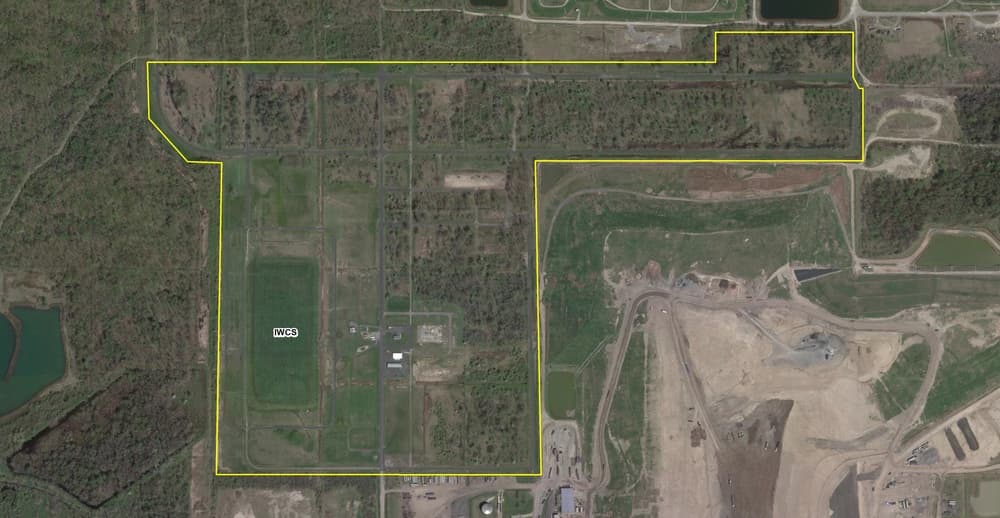
The 191-acre Niagara Falls Storage Site occupies part of the former Lake Ontario Ordnance Works, a federal explosives complex built during World War II to manufacture trinitrotoluene (TNT). The site's original freshwater-treatment plant supplied that production complex. LOOW produced TNT for about nine months in 1943 before it was decommissioned; in 1944, the Manhattan Engineer District began using this part of the property to receive and store radioactive residues and other wastes from the wartime atomic program.
The first documented radioactive shipments were L-50 and R-10 residues from the Linde uranium-processing operation in Tonawanda. Later receipts included L-30 and F-32 residues and K-65 residues created by processing exceptionally high-grade Belgian Congo pitchblende. Federal records also describe Middlesex Sampling Plant sandblast material, contaminated soil and sediment recovered from nearby ditches and properties, and contaminated rubble and debris generated during investigation and cleanup.
The named residue streams carried uranium isotopes, radium-226, and thorium-230. The 2007 federal remedial investigation also reported high concentrations of lead, barium, iron, cobalt, and nickel in L-30 material. Historical shipments from the Knolls Atomic Power Laboratory contained residual plutonium and mixed fission products, including cesium-137 and strontium-90; those Knolls wastes and certain contaminated wartime materials were transferred to Oak Ridge in the late 1950s and are part of the property's history, not a description of what remains in the present containment structure.
DOE consolidated radioactive residues, contaminated soil, rubble, and debris into the approximately 10-acre Interim Waste Containment Structure between 1982 and 1986. The 2007 remedial investigation estimated that structure held about 240,000 cubic yards of material and approximately 2,278 curies of combined radium-226 and thorium-230, plus uranium isotopes and other radionuclides. These are historical federal estimates rather than a claim of a new measurement.
USACE now manages three operable units—the containment structure, balance of plant, and groundwater. Its 2019 decision selected complete excavation and processing of the containment structure's contents followed by permitted out-of-state disposal. Separate decisions address contaminated soil, former infrastructure and road bedding, and a chlorinated-volatile-organic-compound groundwater plume elsewhere on the federal property.
A federal legacy under public watch
The strongest human history is collective stewardship
10 acresinterim containment structure within the 191-acre federal site
1943-1952
A wartime explosives landscape became an atomic-waste destination
The property formed part of the Lake Ontario Ordnance Works, where TNT was produced during World War II. Beginning in 1944, the Manhattan Engineer District used this portion to store radioactive residues and wastes from uranium-ore processing; additional material arrived through 1952.
1982-1986
Waste from across the property was consolidated
The Department of Energy gathered radioactive residues, contaminated soil, rubble, and demolition debris into an engineered earthen containment structure. The work reduced dispersed contamination but also created a long-term federal storage responsibility visible to surrounding communities.
2015-present
Public review accompanies a decision to remove the cell
The Army Corps published alternatives, held meetings, preserved transcripts and comments, and in 2019 selected complete excavation and out-of-state disposal of the containment structure. Project records remain available through Lewiston and Youngstown libraries while design, site work, monitoring, and funding continue.
Manhattan Project: current interim storage of radioactive residues pending complete removal
Bethlehem Steel's uranium program
Federal records identify Bethlehem uranium dust and oxides stored at LOOW. The shipment record does not establish where those particular materials ultimately went within or beyond the larger property.
Read the uranium operation, worker record and material pathways →News record
Major news events
Coverage selected here marks a turning point in public awareness, policy, enforcement, employment, or cleanup. Links open at the original publisher or archive; WNYAtlas does not reproduce restricted articles or images.
Dispersed radioactive residues are consolidated into an interim containment structure
Federal work reduced scattered contamination but concentrated a long-term storage obligation inside a ten-acre engineered cell that communities continued to monitor and question.
U.S. Army Corps of Engineers ↗Complete excavation and out-of-state disposal become the selected remedy
Public review produced a decision to remove the containment structure rather than leave it indefinitely. Design, funding, monitoring, and preparatory work continue; the cell has not yet been fully excavated.
U.S. Army Corps of Engineers ↗Chemical guide
Chemicals named in this record
These links explain potential hazards and exposure pathways. A chemical named in a record does not establish that anyone was exposed or harmed.
Chronology
Timeline
- 1941–1943
The federal government acquired and developed the Lake Ontario Ordnance Works as a wartime TNT-production complex. LOOW produced TNT for about nine months in 1943; the future storage-site tract included its freshwater-treatment plant.
- 1944–1949
Atomic-program storage began with L-50 and R-10 uranium-processing residues shipped from Linde in Tonawanda. The Manhattan Engineer District transferred control to the Atomic Energy Commission in 1946.
- Late 1940s–1954
Additional L-30, F-32, K-65, and Middlesex materials arrived. Knolls Atomic Power Laboratory also shipped boxes and drums containing residual plutonium and mixed fission products during 1952–1954.
- Late 1950s
The Knolls wastes and certain contaminated metal, concrete, lumber, and reduction slag were transferred to Oak Ridge, separating those historical receipts from the material later consolidated at NFSS.
- 1970–1981
Federal surveys identified contamination on the site, in drainage corridors, and on surrounding properties. Cleanup placed thousands of cubic yards of recovered soil and sediment with the site's residue piles, and routine monitoring began.
- 1982–1986
DOE built the engineered Interim Waste Containment Structure and consolidated radioactive residues, contaminated rubble and debris, and soil from NFSS and vicinity-property cleanups. Federal records report roughly 50,000 cubic yards came from the remediated vicinity properties and drainage ditches.
- 1997
Responsibility for the federal Formerly Utilized Sites Remedial Action Program transferred from DOE to the U.S. Army Corps of Engineers.
- 2019
USACE signed the decision to remove the entire containment structure and dispose of its contents out of state.
- 2021–July 2026
Detailed design advanced while USACE continued security, maintenance, environmental surveillance, and planning for the remaining operable units.
Environmental record
Documented impacts
- The containment structure holds documented uranium-processing residues, contaminated demolition debris, and soil from the main site, drainage corridors, and vicinity properties. Principal radionuclides include uranium isotopes, radium-226, and thorium-230.
- The imported residue inventory includes L-50, R-10, L-30, F-32, and K-65 materials associated with uranium recovery at Linde in Tonawanda and processing of high-grade Belgian Congo pitchblende. The 2007 federal investigation estimated approximately 3,200 cubic yards of K-65, 9,400 cubic yards of originally delivered R-10, 7,960 cubic yards of L-30, 440 cubic yards of F-32, 2,150 cubic yards of L-50, and 230 cubic yards of Middlesex sandblast material; later mixing and cleanup consolidation changed the volumes of some piles before containment.
- Non-radiological contaminants documented in portions of the residue or site media include lead, barium, iron, cobalt, nickel, and chlorinated volatile organic compounds. Their locations, concentrations, and cleanup pathways are not uniform across the property.
- Historical Knolls waste introduced plutonium and mixed fission products including cesium-137 and strontium-90, but federal records state that material was moved to Oak Ridge in the late 1950s. It is included to explain the full history of what was brought to the property, not to claim it remains in the containment structure.
- Balance-of-plant soil, road bedding, former foundations and utilities, and a chlorinated-solvent groundwater plume are addressed separately from the containment structure under the federal cleanup program.
Response
Cleanup and controls
- USACE maintains site security, operations, the containment structure, and environmental surveillance while removal is designed.
- The selected source remedy calls for complete excavation, processing, and permitted out-of-state disposal of the containment structure contents.
- After removal, underlying soil will be investigated and remediated as necessary under the balance-of-plant and groundwater cleanup goals.
Then and now
The site today
NFSS remains an active federal remediation site and radioactive material is still stored in the Interim Waste Containment Structure. USACE reports that the structure is performing as designed and remains protective, but the selected remedy is complete removal and out-of-state disposal—not permanent retention—and that removal has not been reported as complete.
Atlas connections
Connected places
These collections explain documented material, facility, waterway, ownership, or cleanup relationships. Inclusion does not imply that every place shares one contaminant source or plume.
Niagara regional radiological record
Federal storage, industrial processing, vicinity-property cleanup, and later residential or public-property investigations form a connected regional research record.
The storage site is the principal federal property in a wider network of material handling, containment, and vicinity-property work.
Vicinity propertiesNiagara Falls Storage Site Vicinity PropertiesThese properties are managed separately where eligible material lies beyond the principal storage-site boundary.
Wartime industrial facilityElectro Metallurgical CompanyElectro Metallurgical represents a separate Manhattan Project-era industrial operation within the Niagara record.
Investigated propertyNiagara Falls Boulevard Radiation SiteThis location was identified through later radiological investigation rather than treated as part of the NFSS parcel itself.
Public-property responseDonovan Head Start Slag RemovalThe Head Start response documents investigation and removal at a public-use property.
Investigated propertyUpper Mountain Road Radiation SiteUpper Mountain Road is one of several separately bounded locations in the regional assessment record.
Vicinity investigationHoly Trinity Cemetery VicinityThe cemetery vicinity record is linked by regional radiological assessment, not by a claim that every property shares one source.
Regional assessmentNiagara–Erie Residential Radiological AssessmentThe assessment provides the umbrella research context for evaluating multiple residential and public locations.
Radiological-map connection
Place this site in the wider material history
The separate radiological investigation map distinguishes producers, processors, storage, the 100 historical survey records, federal remediation, and current assessment coverage.
Linked research mapOpen the radiological investigation →