radiological · Erie County
Linde Air Products
Town of Tonawanda
Manhattan Project uranium processing and the regional FUSRAP story.
The documented story
What happened here?
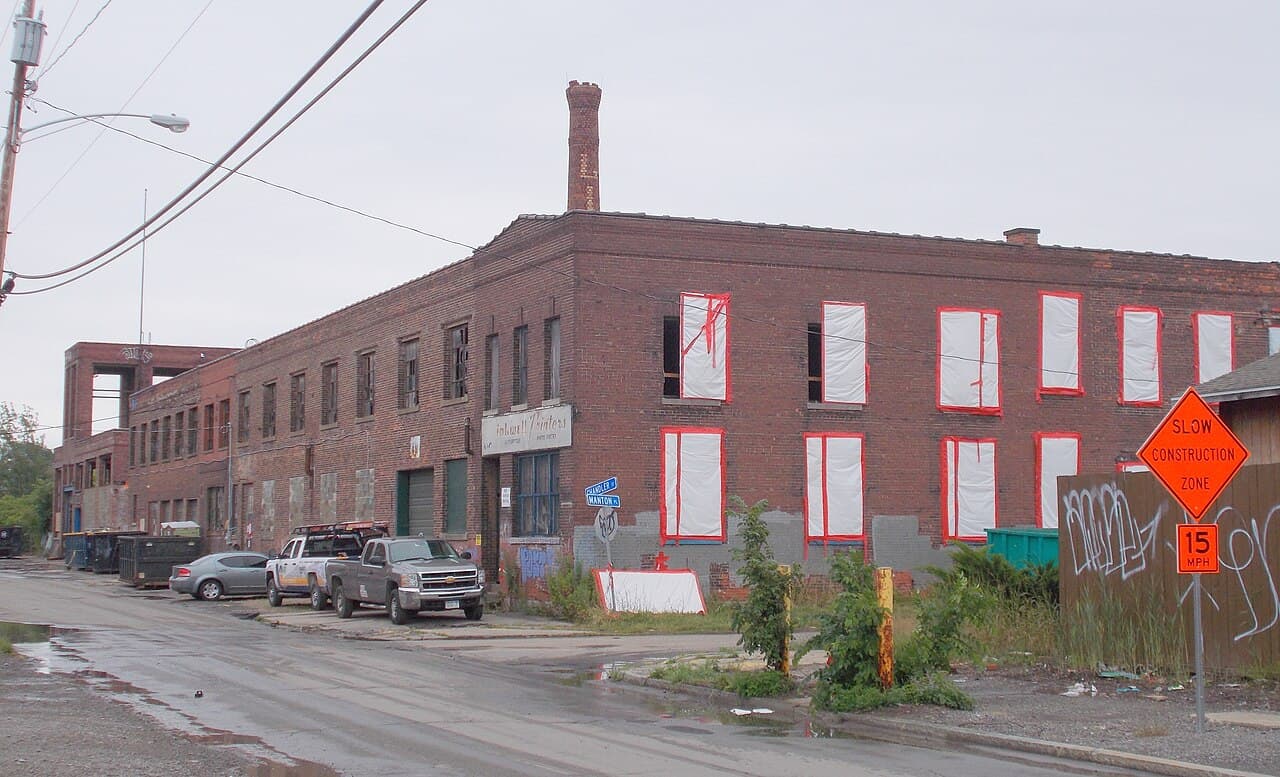
Between 1942 and 1946, the Manhattan Engineer District contracted with the Linde Air Products Division of Union Carbide to process uranium ore at this Town of Tonawanda industrial facility. Work included separating uranium dioxide from ores and converting uranium dioxide to uranium tetrafluoride.
Processing affected portions of the property, buildings, infrastructure, sediment, soil, and groundwater. Later handling and disposal also moved Linde-related material to other Tonawanda locations, making the site central to understanding the region's connected FUSRAP landscape.
Linde's liquid-waste history - including well injection, sewer discharge, and overflow toward Two Mile Creek - is a separate pathway from solid residues moved to the Ashland, Seaway, and Tonawanda Landfill properties. WNY Atlas does not merge those routes or use one as proof of the other.
Workers carried out a secret wartime assignment
Linde's uranium work became both a cleanup and worker-compensation history
1942-1947principal period covered by the Linde Special Exposure Cohort class
1940s
A ceramics and gases plant entered the Manhattan Project supply chain
Linde developed and operated processes that separated uranium from ore and produced uranium tetrafluoride for metal production elsewhere. The work linked Tonawanda employees to a national weapons program whose purpose and hazards were constrained by wartime secrecy.
After production
Residues moved beyond the source buildings
Uranium-bearing material was stored or disposed at the Linde property and other Tonawanda locations, creating the connected Linde, Ashland, Seaway, and Tonawanda Landfill FUSRAP history. Federal cleanup addressed defined properties rather than treating the town as one undifferentiated site.
Federal compensation era
Incomplete historical dose records acquired a human consequence
A class of qualifying Linde employees was added to the federal Special Exposure Cohort. That designation provides a route through the Energy Employees Occupational Illness Compensation Program when employment, work-duration, and specified-cancer requirements are met.
Manhattan Project: uranium-ore refining and uranium tetrafluoride production
Chemical guide
Chemicals named in this record
These links explain potential hazards and exposure pathways. A chemical named in a record does not establish that anyone was exposed or harmed.
Chronology
Timeline
- 1942–1946
Linde performed uranium-processing work for the Manhattan Engineer District.
- 1944–1946
Liquid process wastes were initially discharged to town sewers and were also routed to five approximately 150-foot-deep on-site wells. Plugging or overflow could divert effluent through a former storm-drainage ditch to Two Mile Creek.
- June 1981
A federal survey sampled the former liquid-effluent pathways, including disposal wells, sewers, Two Mile Creek and comparison waterways.
- 1980
The Department of Energy designated the property for remediation under FUSRAP.
- 1996–1997
DOE began investigation and removal work; Congress then transferred FUSRAP cleanup execution to the U.S. Army Corps of Engineers.
- 1997–2013
USACE excavated contaminated soil and removed affected building surfaces and infrastructure for licensed off-site disposal.
- Present
The property remains an active industrial-gas facility under long-term stewardship for the completed FUSRAP remedy.
Environmental record
Documented impacts
- The contaminants of concern included radium-226, thorium-230, uranium isotopes, and associated decay products.
- Contamination was documented in surface and subsurface soil, sediment, structural surfaces, and groundwater.
- Waste relocation linked the Linde history to the Ashland, Seaway, and Tonawanda Landfill FUSRAP records.
- EPA's 1982 overview reports that about 37 million gallons of wastewater containing radioactive materials were injected into the five on-site wells. This liquid route is separate from the off-site movement of solid residues.
- DOE's 1981 survey generally found sampled Two Mile Creek soil, sediment and water comparable to baseline locations, while higher concentrations were measured on site near former disposal wells. Those historical results do not substitute for current sampling.
Response
Cleanup and controls
- Remedial work removed affected soil, building surfaces, and infrastructure for disposal at licensed facilities.
- Cleanup criteria were based on the site's anticipated commercial and industrial use.
- Long-term stewardship preserves records and verifies that the completed remedy remains protective for the intended land use.
Then and now
The site today
The privately owned property continues to operate as an industrial-gas facility. A completed FUSRAP cleanup does not erase the site's Manhattan Project history; it changes the story from active remediation to stewardship and land-use context.
Atlas connections
Connected places
These collections explain documented material, facility, waterway, ownership, or cleanup relationships. Inclusion does not imply that every place shares one contaminant source or plume.
Tonawanda FUSRAP material network
Uranium-processing residues and related material moved among industrial properties, storage areas, landfills, and vicinity properties in the Town of Tonawanda.
Linde processed uranium ores for the Manhattan Engineer District, creating residues later addressed at multiple Tonawanda properties.
Interim storage propertyAshland 1 / Former Ashland Oil RefineryThe former refinery property received Linde-related residues before portions of the material were moved again.
Related cleanup propertyAshland 2 FUSRAP SiteAshland 2 forms part of the federal Tonawanda FUSRAP cleanup record and its connected material history.
Landfill containment siteSeaway FUSRAP Site / Tonawanda North Unit 3Material moved from Ashland 1 in 1974 became part of the radiological remedy at the Seaway landfill.
Vicinity propertyTonawanda Landfill FUSRAP Vicinity PropertyThe landfill vicinity record tracks qualifying material outside the principal federal cleanup boundaries.
Related disposal propertyNiagara Mohawk–Cherry FarmCherry Farm belongs to the broader Tonawanda record of industrial disposal and radiological investigation.
Radiological-map connection
Place this site in the wider material history
The separate radiological investigation map distinguishes producers, processors, storage, the 100 historical survey records, federal remediation, and current assessment coverage.
Linked research mapOpen the radiological investigation →School-map connection
See the documented campus relationship
The schools research map explains the documented property, adjacency, or mapped-parcel relationship without treating proximity as evidence of exposure or present school conditions.
Linked schools mapHOLMES ELEMENTARY SCHOOL →