cleanup · Niagara County
Hooker / Hyde Park Landfill
Town of Niagara
Former Hooker Chemical landfill that received about 80,000 tons of chemical waste, including dioxin-bearing material. The landfill and perimeter are capped, contaminated groundwater is hydraulically contained and treated, and community monitoring wells remain in use.
The documented story
What happened here?
Hooker Chemical used the approximately 15-acre Hyde Park property from 1953 to 1975, disposing of roughly 80,000 tons of chemical waste. EPA records identify the landfill as one of several separate Niagara Falls disposal sites operated by Hooker; it must not be conflated with Love Canal, S-Area, or 102nd Street.
The disposal area sits in fractured Lockport Dolomite about 2,000 feet southeast of the Niagara River. Contaminants moved in aqueous and non-aqueous phases through overburden and bedrock, while Bloody Run provided a surface-drainage route through storm sewers and down the Niagara Gorge toward the river.
A 1981 federal settlement established the cleanup framework. The resulting remedy combined source and perimeter covers, collection drains, bedrock and overburden hydraulic containment, recovered-water treatment, gorge-face seep work, and a community monitoring-well network rather than attempting to excavate the entire landfill.
A community contested the remedy
Public scrutiny helped shape a containment system built to last
7 daysof court-ordered evidentiary hearings on the 1981 settlement
1979-1982
A proposed settlement was tested in public and in court
After the federal government sued in 1979, the 1981 settlement drew substantial public objections and a request for an evidentiary hearing. The court ordered seven days of testimony in which government, company, local, and Canadian environmental representatives presented and cross-examined witnesses before the agreement was approved in 1982.
1985 onward
The remedy followed contamination beyond the fence
The final system addressed the landfill, fractured-bedrock groundwater, Bloody Run drainage, storm sewers, and Niagara Gorge seeps. A residential community-monitoring program added wells outside the industrial property to check whether contamination was moving toward nearby homes.
2003-present
Completion means managed protection, not an empty landfill
EPA recorded cleanup construction as complete in 2003 and removed Hyde Park from the Superfund list in 2013. The buried waste, caps, pumping, treatment, easement, and monitoring remain; the community's protection depends on those systems continuing to work.
Historical aerial evidence · third release
From the operating landfill to the long-term remedy
A newly verified USGS frame records the Hyde Park Landfill area in 1958, five years after disposal began. Four later New York State orthophotos then use one fixed geographic window around the landfill, adjoining industrial properties, the Niagara Power Project, nearby neighborhoods, and the Niagara Gorge. No pre-1953 Hyde Park frame was available from the online USGS catalog; New York State's 1938 Niagara County photographs remain an archive lead rather than a published comparison image.
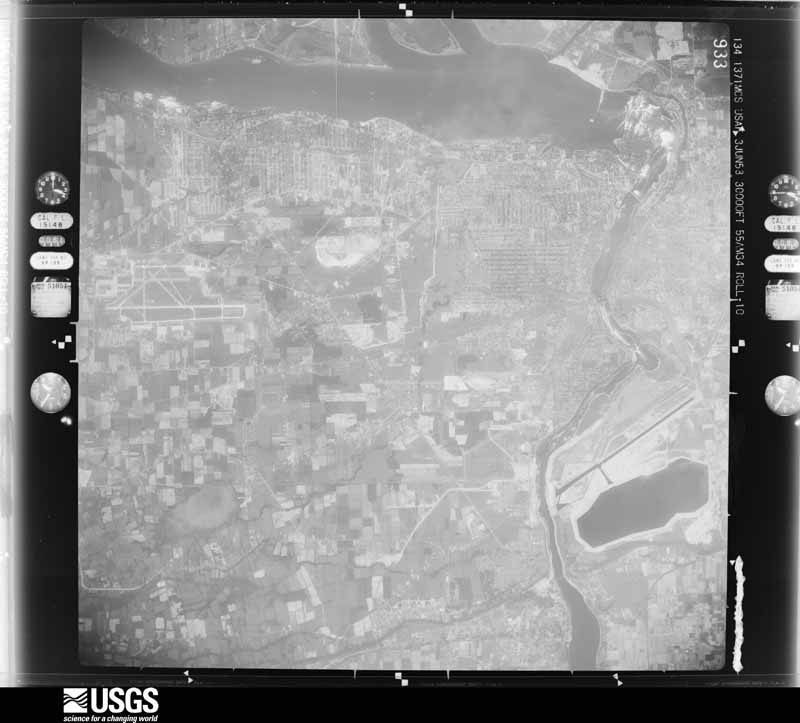
USGS acquired this 1:60,000-scale frame on June 3, 1958. Its recorded footprint contains EPA's published Hyde Park site coordinate, placing the photograph within the documented 1953-1975 disposal period. The yellow guide locates the property approximately; the photograph alone does not identify waste or contamination.
USGS frame ARA550340100933 ↗Choose a year. On touch screens, swipe the image to move through time.
News record
Major news events
Coverage selected here marks a turning point in public awareness, policy, enforcement, employment, or cleanup. Links open at the original publisher or archive; WNYAtlas does not reproduce restricted articles or images.
Federal settlement makes Hooker responsible for the Hyde Park cleanup
The $16.5 million agreement was described at the time as an unusually comprehensive industrial cleanup settlement and an early model for resolving major toxic-waste cases.
The Washington Post archive ↗Chemical guide
Chemicals named in this record
These links explain potential hazards and exposure pathways. A chemical named in a record does not establish that anyone was exposed or harmed.
Chronology
Timeline
- 1953-1975
Hooker Chemical disposed of about 80,000 tons of chemical waste at Hyde Park.
- 1979-1981
Federal action and a 1981 settlement established responsibility for investigation, containment, treatment, and long-term monitoring.
- 1985
EPA selected the core remedy for the landfill, contaminated groundwater, Bloody Run drainage, and Niagara Gorge seep pathways.
- 1986 onward
Community monitoring wells and expanded containment systems were installed to check conditions outside the industrial property.
- 2003
EPA records construction of the site remedy as complete, beginning the long-term operation and review phase.
- Present
Caps, extraction and treatment systems, monitoring wells, institutional controls, and five-year reviews remain necessary because waste and subsurface contamination remain.
Environmental record
Documented impacts
- EPA-era records describe chlorinated organic compounds and dioxin-bearing waste; historic quantity estimates should be read as agency estimates, not a complete shipment inventory.
- Contaminated groundwater and separate-phase liquids moved through fractured bedrock beyond the original disposal footprint.
- Bloody Run, storm sewers, and Niagara Gorge seeps were investigated as distinct migration pathways toward the Niagara River.
Response
Cleanup and controls
- Landfill and perimeter caps isolate waste and reduce infiltration.
- Hydraulic-control wells capture contaminated groundwater for treatment.
- Community monitoring wells, gorge-seep work, maintenance, institutional controls, and five-year reviews verify containment.
Then and now
The site today
Hyde Park is a contained, treated, and monitored Superfund landfill. EPA reports that the completed remedy no longer poses a threat to nearby residents or the environment; that conclusion depends on continued operation of the engineered systems and does not mean the buried waste was removed.
Atlas connections
Connected places
These collections explain documented material, facility, waterway, ownership, or cleanup relationships. Inclusion does not imply that every place shares one contaminant source or plume.
Hooker Chemical landfill network
Several Niagara Falls disposal sites share a corporate and chemical-manufacturing history while retaining separate boundaries, remedies, and present-day controls.
Love Canal is the best-known Hooker disposal site, but its remedy and neighborhood history are site-specific.
Industrial landfillHooker / Hyde Park LandfillHyde Park is a separately managed landfill with its own migration pathways and remedy.
Niagara River landfillHooker / 102nd Street LandfillThe 102nd Street site connects Hooker disposal history directly to the Niagara River shoreline.
Industrial disposal areaHooker / S-Area LandfillS-Area is another distinct Hooker disposal property governed by its own cleanup record.
Facility-to-river pathwayPettit Flume / Durez OutfallThe Pettit Flume record follows a documented industrial drainage and outfall pathway associated with the Durez operation.